

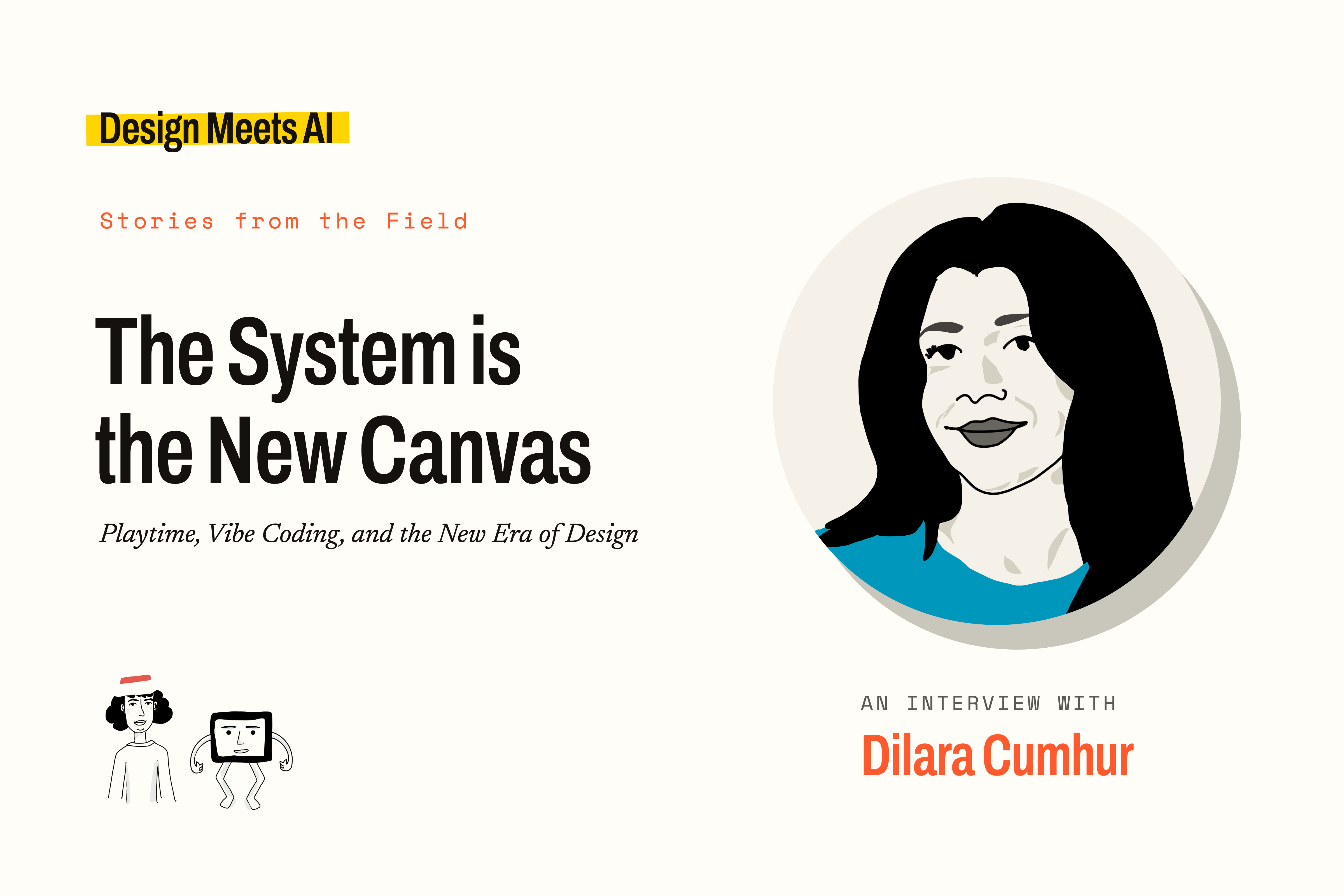
I recently met with Dilara Cumhur, a design leader in the fintech space who has been instrumental in building new teams at Klarna and Visa. She’s now heading to Wise to do the same. We had a great time discussing design, AI, and what should stay human. What stuck with me is her deliberate approach to using AI to 'extract her brain' into a personal leadership system, her commitment to protecting low-stakes 'playtime' for her team, and her fascinating perspective on how the system—rather than just the 2D screen—is becoming the new design canvas.
Without further ado, enjoy.
Kursat: Thank you so much, Dilara, for joining us at Design Meets AI. I’m super excited to host you, as I’m impressed by the work you’ve been doing in the fintech space. Can you tell us about yourself and your journey as a designer? How did it start, and what brought you to where you are today?
Dilara: Thank you so much, first of all, for having me. I’m very much looking forward to the opportunity to speak with you, as I’ve been following your work for quite some time and admire your impressive academic background and the way you apply it in practice.
I had an engineering background. I realized in the third year of my undergrad that I wanted to do something related to design, but I didn’t really know how to navigate that space in a way that would give me the same problem-solving fulfillment I got from engineering while also giving me a creative outlet. I got into a graduate program in Design Management at Pratt Institute, where I had the chance to learn to design products, integrate business knowledge into design practice, and lead innovative workplaces, including applying design thinking across different industries.
As soon as I arrived in New York, I was pulled into a Turkish creative network where they introduced me to UX design at that time, and I felt like that was a good mix for me to bring my problem-solving skills and the energy that I was getting from engineering, but also apply it to a creative field. I worked with people around me who are founders, helping them build their first product ideas and zero-to-one projects to build my portfolio. And after a couple of years working and studying in that program, I fully shifted into product design, and it’s been 13 years.
I’ve spent much of my career at growth-stage companies, scaling products across different markets and languages. Moving to Europe was an exciting transition; Berlin’s tech scene was booming, so I relocated to work on various products there. Over the last seven years, I transitioned heavily into fintech. Joining Klarna in 2019 was a notable milestone—they were establishing a new hub in Berlin to tap into the local talent and launch their banking product in a fresh market. It was a fantastic zero-to-one opportunity to build a hub and a brand presence from scratch. I was determined to build a strong design team and create products alongside a group that shared a founder mindset. I went on to manage teams of varying sizes there, which eventually led me to other fintech and B2B roles.
After Klarna, I joined Visa, which has been another interesting journey. I was brought on to build a new regional hub. That has essentially become my expertise—jumping in to build teams with a builder’s mindset while maintaining clear foresight for the next stage of growth.
Navigating companies at various stages has allowed me to continuously refine my approach with new tools and expertise. Over time, this evolved into advisory work, helping fintechs build the right teams, establish strong foundations, and guiding founders to avoid early mistakes. Ultimately, I thrive on joining companies to drive quality, level up products, or build from scratch—I always bring that forward-looking energy.
And now, after 10 years in Berlin, I recently moved to London to start a new journey here.
Where the energy comes from
Kursat: It’s amazing how you built that capacity over the years, and now you are jumping in and starting another from zero to one. Once you had that experience at Klarna and moved to the next role, what was your thought process? As a practitioner, do you reflect and carry them into the next thing?
Dilara: Yes, I do a lot of reflection. I’m a big fan of journaling in my personal life. I’ve been journaling since 11. My mom was always making fun of me for having agendas for everything. But I think intentionality is something we bring into design practice a lot; I try to live by it consistently in my personal life and in my leadership work as well.
When I joined Klarna, the company was in a hypergrowth phase. I’ve been there for three years, but I would say it's been quite a dog's years of experience. We had a lot of space to build and scale, and I had that agency within the company. It was quite action-oriented, and they were also quite a disruptive profile within Europe, especially when we think about traditional banking there. So that DNA actually enabled me to grow within the company and take on different challenges. In my final year at Klarna, I led a team of over 100 people in the product design organization, which exposed me to a range of product and people-related challenges.
And the reflection, to your point, was something I actually did later than I think I should have. But one thing that was true to me is: why did I even get into design in the first place? Like, where do I get my energy? Is that place still fulfilling that, or is my job done here to the best of my ability? So at that stage, I really missed having that space where I can still get into creative mode. It’s not necessarily about pushing pixels, but about having a small team where you get to work with the team and find yourself in those creative outlets, which wasn’t always possible in such a large organization. And that’s how I moved into leaner teams afterward.
Kursat: That makes sense, because you want to be closer to the design craft. I can see where you lean in: one challenge done, then moving somewhere new where you find your energy and can keep exploring that design space.
A one-hour Friday play
Kursat: I want to switch gears and talk about AI. After 2023, everything started changing with generative AI, and over the past year or so it’s been moving at a crazy pace. How is AI changing your design practice, and where do you see it evolving? You can take this from either angle, designing with AI or designing the AI, whichever you feel strong about.
Dilara: Well, lots to say, but I guess what I wanted to play back was what you said about what happened in the past year at that accelerated speed. I think over the past year, since we now have tools that help us visualize our ideas beyond just having a conversation, it has become a very clear artifact for many people, and that has unlocked many people at a drastic pace. When I first started interacting with LLMs like ChatGPT, I felt I had found a sounding board.
One of the things I started using a lot that helped me in the design practice is building the muscle to externalize and extract my brain into a system. I’m having a conversation at a very simple level, and then there is an output. But over time, I’ve been quite active in using this to think and formulate my thoughts within my leadership scope. So if I need to do a performance review, for example, how do I build up that context? I’ve been already having my context in manual forms because I’m writing a lot. So I started training myself to group them, setting the context early on. And then, as the tools start maturing, like when we start creating md files, projects, and all these context hubs, I’ve been using AI quite actively.
And another thing that I’ve created with my team that is super important is the playtime. We knew we wanted to adopt some of those tools to accelerate our work and create new kinds of work we might not have been able to do before. But the tools were also not quite mature at that time. We needed to keep building our AI muscles. To help build that muscle, I set up a routine with my team: a one-hour Friday play. And we were going to protect our time at all costs. I told my team that if somebody has put a meeting off, just let me know. I really wanted to establish it so it doesn’t fall through the cracks, and we can start building that routine. And we started having these workshop sessions. And every other week we use one of the critique sessions to showcase something that they revealed with the tool.
Over time, the team began coming up with different ideas when there were no high stakes, allowing creativity to bloom. We actually managed to use some of it in the client pitches. That wasn't a set outcome, but that play environment enabled it.
Extracting your brain
Kursat: I love that. You have multiple threads running at the same time, building muscle both personally and with your team. Can you speak more to extracting your brain? An example might help our readers.
Dilara: Yeah, definitely. One of the benefits of this journaling practice is that it has really helped me keep a record of my work and thought process quite consistently over the years. When I was having a conversation with AI and read back the results of that reflection, I felt like I was reading another business book, or someone who was just talking fluff; it felt too sterile and not like me.
And I reached a point where I thought, I have these leadership principles, and I have a strong point of view on design. And how do I extract that? I actually have a ton of content that I put out there for many years. I have my case study notes and my behavioral interview notes for “tell me about a time that happened.”I have write-ups for all of that. And some of my colleagues at Klarna were calling me the documentation queen. I asked myself: how can I build a Dilara point of view— an MD file that I can feed into any product challenge? Or when I speak in a session like this, how do I gather my thoughts again? I needed to have a core.
That’s how I trained the system to build my point of view, my interest, my philosophy. I created those files as a context directory. I asked Claude to help me structure what would be helpful for it to give me something more specific. Not to sound like a different sounding board. Tell me what I would say in that context. I started training Claude, which led me to write a point-of-view file. I then drafted a leadership and a design philosophy that include, for example, universal beliefs and those tailored to my experience. I’ve been using this when I'm brainstorming a topic or writing a new case study for an interview. It’s still a work in progress. It’s not perfect, but again, it’s about building the reps.
Kursat: That’s great. I do something similar. I created an interview skill for Claude that interviews me when I have a topic I want to write about for my newsletter. It asks me questions, and I answer. But I love that you go even deeper, into values and leadership principles.
Dilara: Yes, I guess that’s where you can extract the authenticity, because there are very specific things that only we experience. And especially now, with the clouds of content and noise out there, I think people really want to get the gist of who you are, as a person and as a designer.
And another thing that I’m trying to work on is: can I do something similar in certain contexts about my judgment? That’s, I think, the other layer. Because it’s inherently at odds with how LLMs work, judgment doesn't necessarily come directly from the past; rather, when you need to come up with something new, it’s not just the knowledge you've accumulated and fed into the system; judgment comes from within your presence, through your emotions, your belief system. It’s hard to extract that and hand off to AI.
Kursat: Yeah, we still need humans to bring that judgment.
Dilara: Oh, definitely. And why are we giving away the best part of our job to AI? There is a ton of stuff we are paid to do, and still need to do, like the repetitive tasks and whatnot that AI can help with. But the creative part — why do we give away the best part of our jobs, which, again, only we can do best?
What she trusts AI with
Kursat: That brings me to the question of what you trust AI with, and what you always keep human. I guess you kind of answered that already.
Dilara: Yeah, I can definitely expand on that. I trust AI when the output is more predictable, maybe slightly more universal in the way we solve it. And maybe just similar to heuristics, right? We don’t want to reinvent a lot of stuff if it’s already working. Things that are at scale, more predictable, and we’ve already gotten, let’s say, to a certain level of confidence that the output is consistent. When I test that and find that the confidence is high, then I would rely on AI.
Where I don’t trust it is when I need to do something new. Meaning, if I need to come up with a new solution to a problem, I still need to be very articulate and specific about what I’m using it for, but I trust it to use it in that context more as a sounding board, like, please interview me, please ask me these questions. So it unlocks the things in me but doesn’t find the answers for me. When it comes to new product ideas, how can I approach the situation differently? I still try to trust my own judgment in the end; I make the final decision.
Kursat: When things are more predictable, or even in exploration, you can trust AI. But when it comes to a new design space, especially one with high stakes, you’re putting your design judgment on the line, because you’ll be responsible if a design idea doesn’t land. Is that the reason? Or do you want to keep that design muscle?
Dilara: I think it’s more like if I need to come up with a new way of approaching a problem or building a product, I don’t think that AI necessarily helped me to get something new out there, because the way it was trained, it’s just really reading the patterns and giving you something that’s already done in a certain way, and then reformulating and packaging it again, giving it to you.
It’s also about how you use it, right? Like, if I say, please design this website for me, and then it just shows me... Yesterday I was watching a talk where they showcased a microsite, a screenshot that pretty much looks like a dev tool, because this is just this template, but it was for all-you-can-eat Korean barbecue. It has no food, no deliciousness, no personality. If you’re, for example, saying, “Build me a microsite with the best design practices,” it will probably default to a very lean, clean, so-called zombie UI, as mentioned in the talk.
Kursat: Oh, that’s Katie Dill’s talk. I watched it too. It was a very good one.
Dilara: If we come back to it, I think I can still trust the AI's output if I put more of my human side into the system, right? Like, being more specific, being more opinionated, and very much into the details. For example, when I was building the wardrobe website, I built all the important features first, but then I wanted to add a small vinyl player in the corner because when you’re getting ready, you want some vibes. But when I first prompted with some design details, like references, I wanted a very retro style, brown colors, and to use these strokes, getting into describing to the AI how a person emotionally experiences it, and, in order to do that, use the volume lower here and there. I was just getting very much into the detail of how a human would describe it to another person. With that humane touch and a bit of technical specification, I get to a place that actually feels more human-made. I started building more trust because I was getting better use of its capabilities.
But in high-stakes situations, especially in a fintech context, when we are dealing with financial data and building stuff that can have unintended consequences, I'd probably like to have more human in the loop, more governance, more guardrails.
The system is the canvas
Kursat: We’ve been discussing designing with AI, so let’s slowly get into the design itself. How do you see interaction patterns evolving in the AI era? What are some of the emerging patterns you see in your work?
Dilara: Our artifacts and canvas are changing in terms of design. Back in the day, we were very focused on an open canvas; we built some concepts, then developers took over and turned it into a working prototype, a living thing. And now, with a lower threshold for building things, design space is slowly shifting toward getting to know the artifact and the software as our canvas. So it’s not just a 2D screen, but the system itself, which I think changes the interface from what we see in the front end; we need to better understand how the systems work in the back end.
With that, the consumers of the interface will not only be the end users but also the agents who will take that information and use it elsewhere. We are going to see more integrated systems, and we are already experiencing that. Like, we open Zoom and Granola pops up. Or I click my function button to start Wispr to talk over, and then that script is pushed into the chat. So we see a lot of movement across workflows that don't necessarily occur within a single interface. We are still going to have apps for the foreseeable future, but the whole concept of an app store or standalone apps is going to… I don’t want to say it’s going to vanish, but I think it’s going to change form, because our ways of working and interacting on a daily basis are shifting from one interface to another. In that sense, design will be more contextual. You start off in, maybe, a chat interface, then go to a completely different place, and sometimes you’re not going to interact at all. The system will do that for us.
I was working on a 90-day plan for myself for the new job, and I was talking through all the questions I have built up in ChatGPT. And then I said, " Can you create a page structure for me, standalone, and create something in Notion for me? And then it was just picking and choosing on the screen, and I was just watching, and I was like, you’re doing my job right now. But it was just so fascinating, because I started off on a different screen. But you need to think, as a designer, that your interface will have different permutations and be hyper-personalized for each user. So we need to cater for that. I think service design probably is going to get a lot more attention in this era. You need to think about workflows with a beginning, middle, and end so you can design them better; that will be key. If you don’t, then you’re probably gonna build more Frankenstein interfaces.
Kursat: I love that. I recently wrote a few pieces on this: that AI design is, in its essence, service design, because now you need to think about the front stage, what the orchestration is, and then the backstage, where agents take the task, work on it like little minions, and bring it back; this is the result.
Dilara: I’m actually quite happy, Kursat. I have this moment of finally seeing certain things I learned in design school about service design come into place. It’s a big design challenge, actually, and it is not just limited to an interface we see. It’s exciting.
Kursat: On that fluidity between modalities, where you switch from chat and the AI calls different apps or tools, how do you grasp that as a designer? As a user, you experience it: it opens Notion, creates the thing. On the other side is the person designing it. Service design tools can help there. What else comes to mind?
Dilara: It’s really coming back to the basics of how we build journeys, right? Journey mapping is still gonna help. Depending on the kind of challenge you’re solving, if it’s something that, let’s say, needs to happen over a long period of time, I think a diary study still works. Those fundamentals are what you do on the first day, and what happens, for example, if I start off with a prompt and then it opens an MCP. So I made this system to work for me, but then maybe the internet dropped at that time. So it’s really just using the fundamentals of how we built the happy paths from the perspective of someone who would interact with it. That empathy, how we bring that into journey mapping, is still going to hold true. Another thing is orchestrating multiple interfaces simultaneously. Before, we were only thinking about one product, right? Like, we are on the website; it’s end-to-end; it’s the website’s funnel, the website’s checkout, and then you’re done. Maybe email confirmation takes you back into a deep link in the app, but that was the whole space.
Kursat: Or mobile, or responsive, after you figure out the web.
Dilara: Exactly. Or, for example, there was this one famous thing that was happening in fintech: how do you prevent fraudsters from calling you? I think Monzo, Wise (recently), and Revolut have it as well. If you’re on a call and someone asks you to open the app, you open it, and the app shows that the number isn't associated with Revolut: “This is not a call from us.”
It is also about thinking more from the user's perspective: okay, if I’m talking to the bank, what are the possibilities? Let’s switch away from the screen-to-screen mindset for a bit and think about what somebody's concerns are when they get a call from a bank. It could be a fraudster calling you; they might ask for information. How do you respond next? You go to the app. I think these are the ways to find those high-stakes moments. Or let’s say you’re filling out a credit card application on the go and you have poor reception. What happens afterward? Like, does it interrupt it? Can you come back to the flow? You really need to think about how you would experience it from that perspective.
Kursat: What I also hear is the importance of knowing the workflow itself, and the moments that matter, those edge cases. AI goes with the vanilla, and you really need to get into the weeds.
Dilara: Yeah, exactly. And, you know, in the same talk that Katie did at the conference, there is this thin line between something finished and something actually good. Like, it can look done, but is it actually done? We have this growing noise about design, right? When, for example, there’s an idea we want to push out there as quickly as possible, we’re always the force pulling it back, like, no, we want to do something much, much nicer; give us some time so we can get into the details. And now that everyone has access to the tools, it’s going to be even harder to put governance in place. With that, it’s even more important to have a point of view and feed the system the right things, because governing the work is no longer gonna work in organizations, since somebody else can put in the artifact. But then how do you form an opinion and bring people back to you with the right practices? We now have more responsibility to exercise that point of view and judgment.
Whoever builds has more accountability
Kursat: That was my other question. In the age of vibe coding, everyone can prototype, like product managers and engineers. How do you see design’s role there?
Dilara: It’s great that many non-designers who think creatively have a space to develop a proof of concept. I love the idea that others are doing it. I have a very different view from, like, oh, now everybody’s doing crap. Yes, it might be crap, but it’s good enough to also help cross-pollinate creativity. When I run design sprints at Klarna, more than half of the ideas come from engineers. When I saw that creativity, I couldn’t resist asking, “How were you able to contain that idea for so long?”
As designers, we really need to make it a habit to prevent a long tail of production as much as possible, because you can have a lot of ideas, but once you build something the wrong way, you’re going to deal with the debt for a very long time.
That long tail is where we need more control. And I don’t think we can have a good rapport with our cross-functional partners if we try to prevent them from vibe coding. It’s more about helping them have the right practices in place, and then, once things are going into production, we need to be more there to challenge the thinking, like, what is the right way to do it, or is this even the right thing to build? We need to be more vocal. It’s the articulation of why certain things are worth building and why others are not.
Let’s all stop defending design. But rather, be the thought leader and show them the path: This will solve x problem, here’s why, and here’s how we can do it. Showing that example is critical. Now that we have more tools, we don’t have to wait for all the fixes we think are worth doing. We also need to uplevel ourselves to learn how to do that. I always had this UX debt on Kanban boards, which was often left unaddressed. With AI now in place, get in there and fix it. This mindset and practice could create a lot of accountability. That impacts how team members perceive you when you start delivering outcomes with those fixes. It’s more likely that you bring that authority naturally, so that people are more likely to listen to your best practices as a designer. And that’s the way to influence all the vibe coders to get better at it.
In that sense, we need to get our hands dirty to do what we believe is right. And now we have the tools; we just need to learn how to use them and be allies with the devs. They are also quite helpful and very willing to give back. They just naturally tend to solve problems together, and also have more of that accountability piece, because whoever builds has more accountability.
Kursat: And for that, you need to be comfortable understanding the backstage, what’s going on underneath, and then start shipping. The tools really lower the barrier to shipping for designers, even if it’s only a small improvement.
Dilara: Because I’ve also heard from a lot of my PM folks over the course of time, when designers say, “oh, I want to have a seat at the table”, but then they were also quite concerned that they are only doing whatever is told them to do, but not taking accountability if certain things go wrong. If you have a conviction, you go ahead and do it, then you take the consequences; you learn from it.
Play, power, and unlearning
Kursat: I have a few more reflective questions. First: since the rise of generative AI, where has AI surprised you most, positively or uncomfortably?
Dilara: Wow. Yeah, what surprised me most, in a positive way, was realizing what it felt like to have a healthy level of dopamine since childhood. But that element of play, and how curious you become towards something with a very childlike energy, is something I felt I was losing over the course of my career, as I moved into senior leadership roles where you have to navigate many different tasks and situations. That helps you grow, but sometimes takes away that joy in work. And I think working with AI—being able to create and experiment with new things so quickly—brought back some of that childlike energy. That positively surprised me.
Also, it surprised me in a very interesting way that my mom is also using ChatGPT, and how her behavior towards technology is changing. It’s fascinating to watch for somebody who’s in the Boomer generation. Like, yesterday she was sending me a picture, and when I asked her, “Is that AI?” she was like, “How did you even know?” Because it wasn’t screaming AI. I said, “Not at first glance, but just a little if you look at small elements.”
Kursat: It’s inspiring to hear that AI is bringing you the excitement of a childhood-like play and the joy of exploring something totally new. Next question: what’s one belief about AI and design you’ve changed your mind about since you started working with it?
Dilara: It didn’t necessarily change my belief, but it expanded my perspective in a way that hadn’t happened to me before. Seeing the waves of change, our ability to move through discomfort and unlearning, and how much that unlocks creativity.
During the economic downturn, I felt somewhat pessimistic about the tech industry. With the changes coming with AI, I have realized I need to reset some of my beliefs and unlearn things that helped me get there.
I started seeing the noise as an opportunity to explore the good stuff within. Now I have more tools, so I don’t always have to stick to what’s predictable and pragmatic; I can inject more of my personality. Whether I’m bringing more personality into the brands and companies I’m advising or building my portfolio, I don’t have to limit myself.
I think once we have certain constraints and practices in place, we tend to believe we need to follow them going forward. I was thinking of those things linearly, when they were coming in waves and loops.
Kursat: I love that. Over the years, you grow these biases or limitations, and AI kind of loosens them.
Dilara: Yeah. And you’re rewarded for doing that. I literally wrote a post about this: being pragmatic by default will hold you back in this era. And that was rewarding you in the place where you need to move fast, and I think a percentage of that will still help you at work. But what about the other piece, where you need to unlock more of AI's possibilities? Instead of only focusing on what you do today and accelerating it, focus on what you have not done or wished to do before. How can you do that now? All of the delighters that we used to say, “Oh, it’s nice to have.” It’s not nice to have anymore. Because now you have the tool, and you’re also best positioned as a designer to articulate and build it, or, if not, get help learning how to build it.
Be okay with the work in progress
Kursat: Last question, and then we’ll land the plane. What advice would you give designers navigating this mix of excitement and anxiety around AI?
Dilara: It is super important to create a space where you can play without having any stakes on the table. Start looking into your own day-to-day life. Try to find a problem that is painful enough that you keep dealing with it, and channel that play energy into it. This is a great place to at least find some calm amid the noise out there.
Another thing is the perception. We are now in a world where many people are talking about AI, even as they still figure out the best way to use it. It’s easier to think that everybody has figured it out or is an expert in certain things, and a lot of that feeds imposter syndrome. They really shouldn’t have that perception. Whatever you do, you’re going to be 1% better than yesterday, and a lot of people are still trying to figure that out. Stay curious; really hone in on your very core designer muscles. Be playful, create that space, and that will naturally come into work. If you get out of that anxiety state and create a play space, it’s easier for you to see certain things from that lens and apply them to work without having that anxiety.
And finally, keep building the reps. Tools are not perfect today. You’re gonna build that muscle to think about how you can use it as your sounding board. You cannot wait for tools to master themselves. Keep using them, and always keep in mind that they’re not perfect either. They are also figuring themselves out as we are trying to figure out how to work with them. So be okay with being a “work in progress”.
Kursat: Thanks so much, Dilara. This was a great conversation.
Dilara: Thank you for having me, and creating a space for it. Just to add that I’m also still figuring it out. Maybe in six months I will have different beliefs and expanded thoughts on some of the things we talked about. I try to extract as much as possible from what I know for now.
And that was a wrap on this issue. Until next time, take good care of yourself and your loved ones.
The failed handoff between tools belongs in the journey map as much as the successful result.