

I’m not a music person. Still, a few months ago, I found myself playing with Suno and creating my own Anatolian rock song. For those who don’t know Anatolian Rock, it’s a genre that started in the 1960s, fusing Western rock with traditional Turkish folk instruments—a complex cultural blend that made evaluating the AI's output incredibly difficult. It was impressive, and it gave me an idea for a website and a tool that lets anyone experiment with their own Anatolian rock beats. When Claude and I built it, the tool took my idea and found subgenres within Anatolian rock music. I was blown away, and I was also totally in the dark about whether it was any good.
I’m not alone in this kind of making. Since generative AI tools became widely available, people have been creating hyperpersonalized tools for their daily lives. When you open LinkedIn or X, you are more likely to hear from a colleague or friend who recently created a super-niche tool for themselves. Some are okay; some are genuinely useful. Reflecting on my own tool-making over the past 12 months, I realized a few things I want to share in this post. AI has lowered the floor for making tools, but it hasn’t lowered the bar for knowing whether they’re good.
We are homo faber, toolmakers who have been creating tools for about 2.6 million years. This innate capability, in a way, helped shape our evolution into homo sapiens. From that perspective, I see the excitement around AI toolmaking as part of our natural evolutionary glitch. That’s what we do, and what we do well.
As toolmakers, people work with AI as a material. In one of our design conversations with Preeti Talwai, we touched on this. AI is a malleable material that doesn’t resemble anything we’ve worked on before, and it’s both exhilarating and intimidating. AI is non-deterministic and can behave autonomously. Compared with our ancestors shaping rock, this material's black-box nature makes it much slipperier to work with.
What does it mean to work with a material so full of life, and what does it mean to have a high-quality tool as an outcome of our toolmaking?
Working with AI is both conversational and logical. You need to know what you are creating and how you are articulating what you are building. Conversational tool shaping can sometimes feel like magic and lowers the barrier to creation. However, the ceiling — what good looks like — is a totally different matter. We need the expertise and human judgment to define what a good, useful tool looks like. If homo faber makes the tool, it’s homo sapiens, the knowing human, who can tell whether it’s any good.
From this perspective, what separates a mediocre tool from a useful one still depends on our ability to define usefulness, ease of use, and desirability. In the AI era, the hard part of toolmaking is knowing what good looks like. That takes strong curating and filtering skills, and lived experience attuned to the challenges and frictions as well as the desired states. It also takes empathy and listening to the situation, and the expertise to transform it for the better. This aligns with Herbert Simon’s definition of design as changing existing situations into preferred ones. To make AI toolmaking work, we need to go back to basics and practice design as we scope and build AI tools.
With that framing, let’s look at three tools I created in the past six months. I’ll start with the two where I know what good looks like, and end with the one where I don’t. I built all three in conversation with Claude, so when I say “we,” I mean the two of us.
Ritual Guide
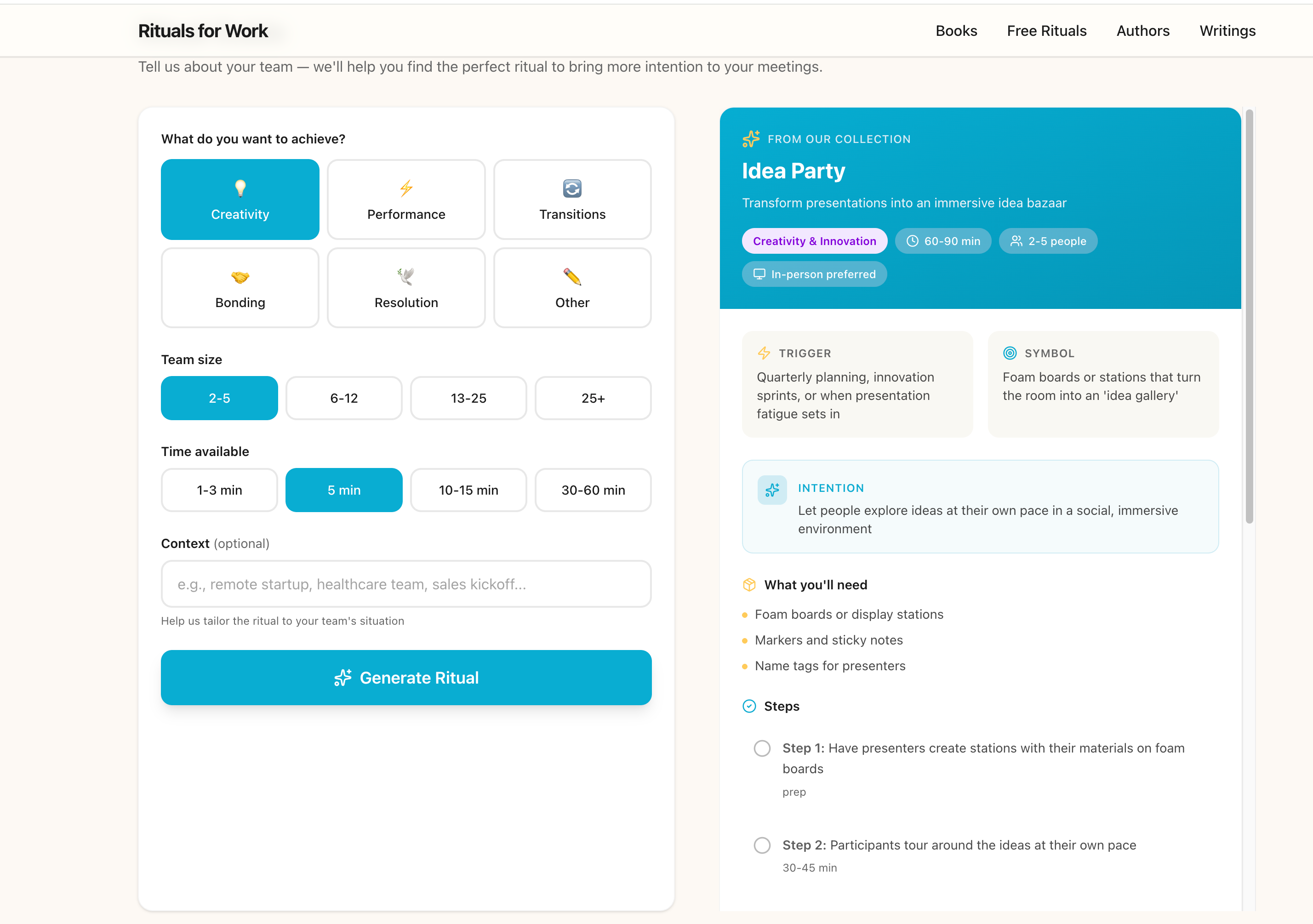
This is a ritual design tool that helps managers and leaders start meetings and gatherings with intention by generating ritual ideas.
I’ve worked on this idea in different forms before. Many years ago, I created a Mad Libs app where you picked three ritual ingredients, and it generated a ritual idea. The new AI-enabled version starts from the team’s situation. You choose what you want to achieve, how many people are in the room, and how much time you have, and it shapes a ritual around that. While building it, we discussed what would happen if the AI call failed, and we agreed to fall back to rituals that are hard coded so no one ends up with an empty page.
For the tool parameters, I used our ritual design canvas: [trigger, intention, symbol, steps, payoff]. When I tested it for this piece, I asked for a five-minute creativity ritual for a team of two to five people. The AI call didn’t go through, and the fallback gave me a 60–90 minute long ritual. The card looked complete, with a trigger, a symbol, and an intention all in place; however, it was frustrating to see that the fallback matched my goal but ignored the time constraint. To fix this, I either need to expand the hard coded fall back ritual repertoire or make sure the API’s working properly.
Persona and Journey map Tool
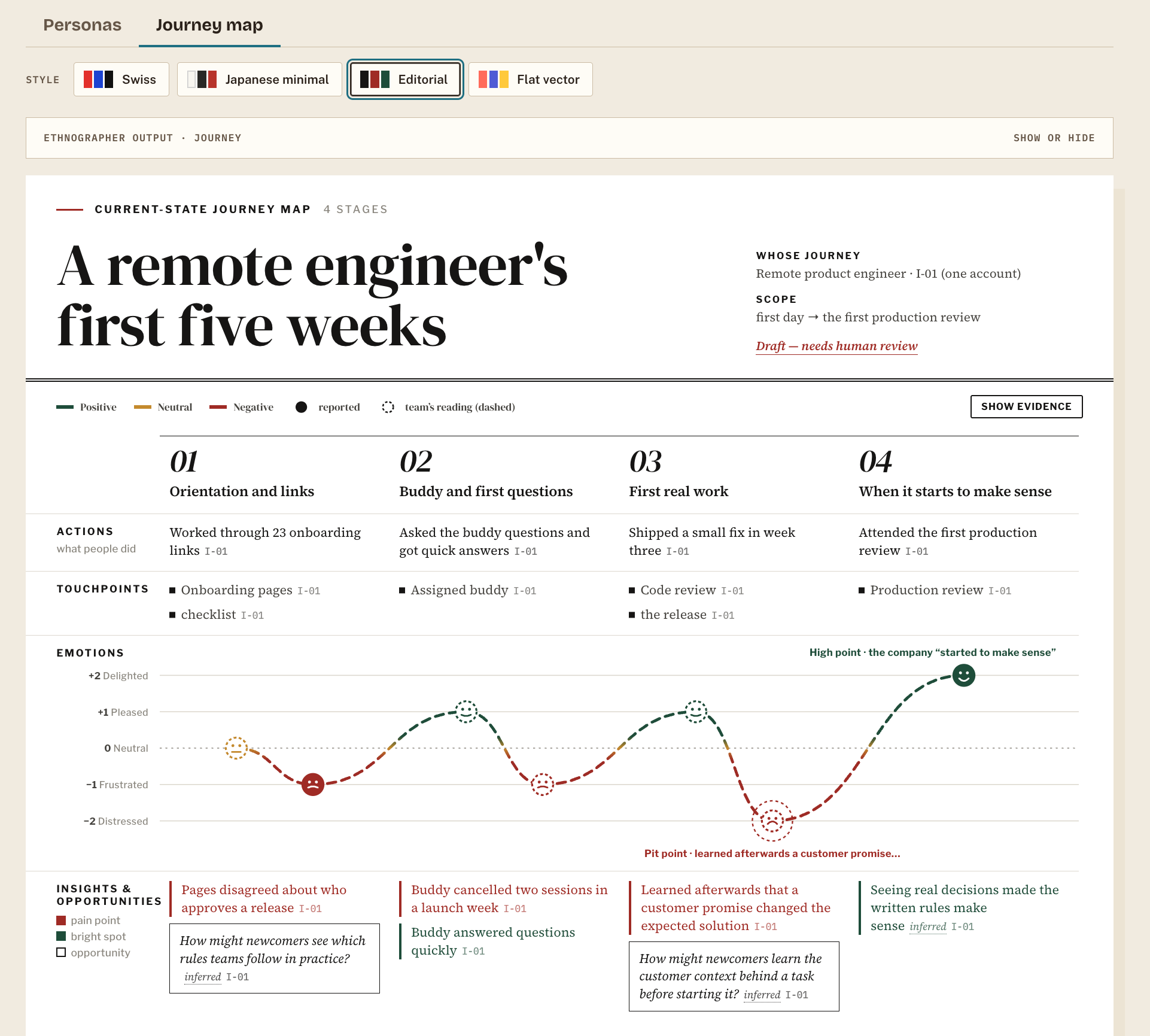
This is a tool for our students to create persona and journey-map artifacts in different visual styles for our Designing Org Culture class.
I created it to support students in their discovery process. While creating the tool, I fed templates, and guides to help AI to create the tool. I was delighted when I added the different visual styles to the journey maps. It’s amazing how easily Claude understands the intent and adjusts the tool scope.
There were also some hiccups in the process. When I first gave the challenge to Claude, my attempt for the tool to create an emotional graph didn’t work. Even though I fed it examples from my previous work, the AI didn’t understand that it needed to connect the data points, so we had a lot of back-and-forth. A good journey map typically gives a glanceable view of the persona’s emotional journey with a visual graph showing the experience’s ups and downs, with clear indications of pain points and bright spots. My prior experience with journey maps enabled me to guide the AI toward a better output. Without that tacit knowledge, it would have been any other process map. I’m now thinking of making this tool standalone so others can try it. For it to perform consistently, I need to create a set of good examples so AI can learn and improve.
Makam Machine
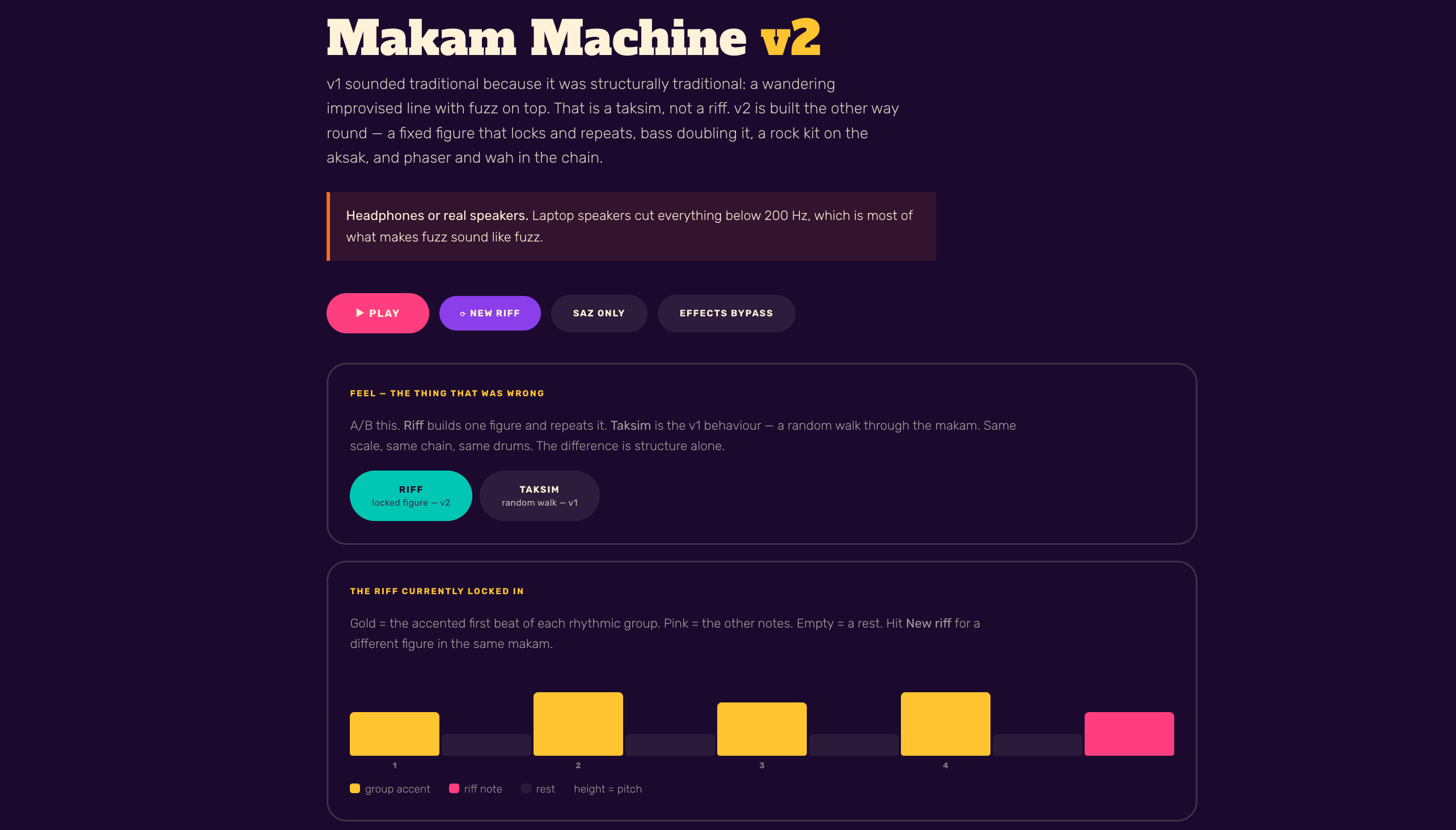
And Makam Machine is for experimenting with your own Anatolian rock beats. While creating the Anatolian rock website, I mentioned to the Claude that it would be cool to create a tool for experimenting with your own version. AI then created a tool with subgenres/makams within the genre that you can adjust and riff off your own beats.
I was both impressed and felt that uncanny feeling of staying in the dark. I have no expertise in the specifics of musical elements. I needed a musician’s take on it. I guess that shows something about the value of human judgment. Without domain expertise, toolmaking is a technical exercise. I can build the Makam Machine as homo faber, but I need homo sapiens’s expertise to evaluate it.
If you have a background in music—especially the nuances of Anatolian rock—consider this an open invitation to audit it. Try the tool and let me know: did the AI actually capture the genre's cultural blend and microtones, or did it just hallucinate a generic synth beat?
AI expands who can make tools, but expertise determines which tools deserve to exist—and which deserve our trust. Taste matters, but it isn’t enough. The deeper standard is usefulness, desirability, and ease of use: the judgment to know not only what we can make, but what is worth making. AI may empower homo faber, but homo sapiens still has to decide what good looks like.
And that’s a wrap for this issue, until next time take good care of yourself and your loved ones.