
Five Designerly Ways of Working with AI
From AI adoption to Intentional AI integration

AI is surrounding us in every possible way—but its impact isn’t there yet. Every day, we hear reports from companies’ AI adoption journeys. I’ve been collecting these stories—pilot reports, research studies, and classroom case studies—to make sense of how AI is evolving within organizations. Earlier this year, our students analyzed how different companies are adopting agentic AI systems. Those insights, alongside my own design practice, helped me articulate what I now call designerly ways of working with AI.
Signals from the Field
The data tell a consistent story. Companies are spending heavily on large language models and custom AI tools, but few move beyond experimentation. MIT Sloan’s State of AI in Business 2025 reports that 95% of projects show no measurable impact [1]. A RAND study puts the number closer to 80% [2].
Leaders announce “AI-first” strategies, only to roll them back months later after layoffs or disappointing results — as seen recently at companies like Klarna, which reversed parts of its automation push after realizing that full-scale AI substitution hurt customer experience and team performance [12][13]. In some cases, firms have even been held legally responsible for misinformation generated by their chatbots—a reminder that accountability still rests with humans, not the model[6].
Meanwhile, a quieter consequence is unfolding inside teams: deskilling.
When AI automates the routine steps, people lose the daily practice that builds mastery. A 2024 study of over 1,400 colonoscopies found that clinicians’ detection accuracy declined after routine exposure to AI. Researchers warn of an erosion of human expertise unless teams intentionally protect space for practice and judgment [5].
Researcher Matt Beane calls this the human consequence of automation. When formal learning pathways narrow, people invent what he terms shadow learning—informal ways to keep their skills alive. It’s an act of resilience, but also a warning: if organizations don’t design for skill retention, employees will quietly unlearn what made them effective in the first place [4].
From Adoption to Integration
These signals point to a broader misconception: most organizations still treat AI as a technical rollout—procure, plug in, and measure efficiency. But sustainable impact depends on how humans and AI learn to work together.
Across my research, teaching, and experiments with AI, I see the need for a holistic approach—one that begins with purpose, experiments with form and material, and embeds new ways of working with AI.
As designers, we don’t just make tools; we shape relationships—between people, intelligent systems, and their environments. We start with why, explore how, and learn by doing. This intentional mindset, long proven in design practice, is what AI integration initiatives need at this point.
Let’s dive into five manifestations of design thinking:
1. Design the Team—the Human–AI Team
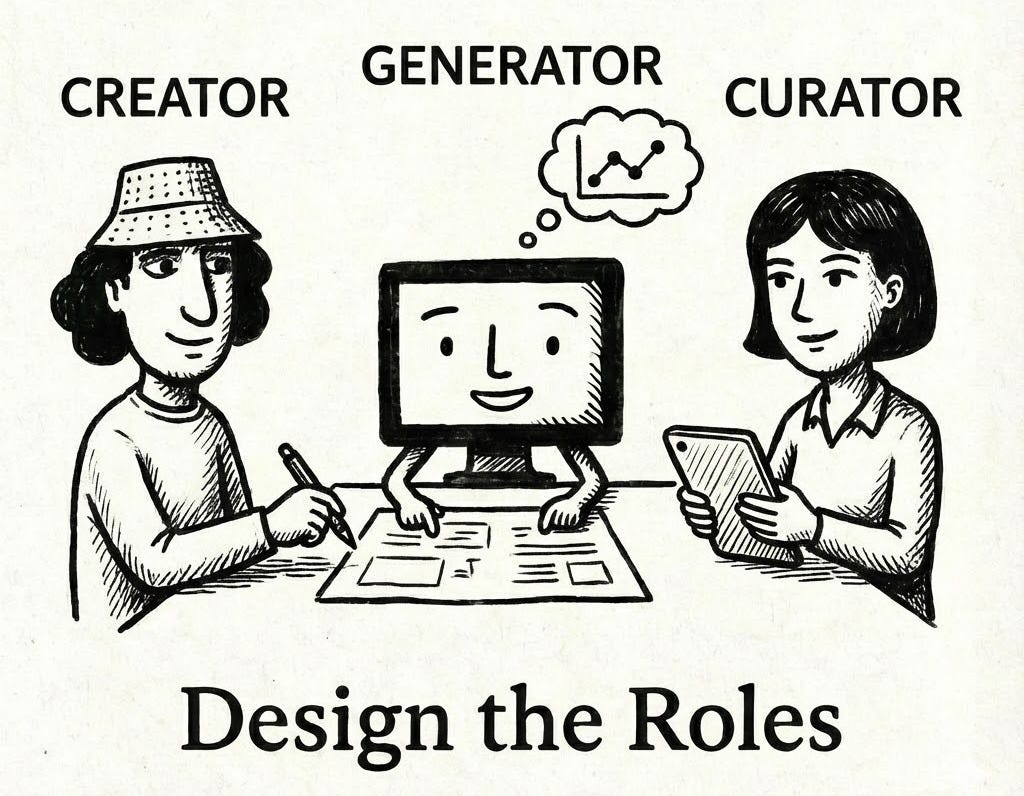
Before designing systems, we must create the team that surrounds them—and increasingly, that team includes AI.
Drawing from Richard Hackman’s theory of real teams[7], Amy Edmondson’s work on psychological safety[8], and Google’s Project Aristotle[3], we know that effective teams rely on three things: purpose, boundaries, and trust.
When an algorithm joins the team, we need to be rethinking these three more intentionally:
Purpose: Is AI serving human goals or quietly redefining them?
Boundaries & Role Clarity: Where do we draw the line between human and machine judgment?
Trust: How do we rely on something we can’t fully see?
Designing the team now means designing the human–AI team—clarifying roles, decision rights, and collaboration norms. The goal in framing AI as a teammate is not to anthropomorphize AI; it’s to re-humanize this new kind of hybrid team around transparency, trust, and shared mental models.
2. Redesign the Workflow—Start with the “Why.”
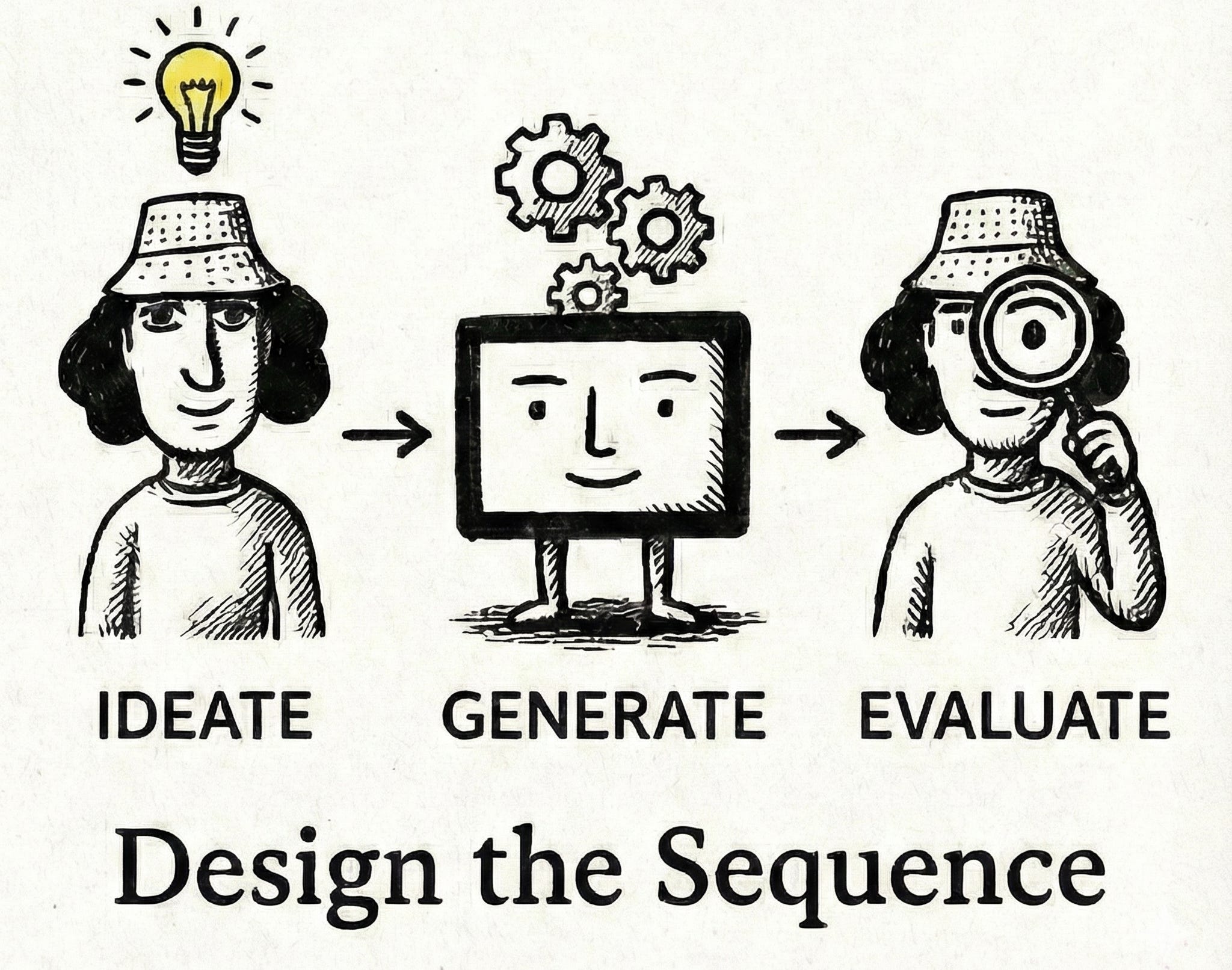
AI is often inserted into workflows to accelerate steps that don’t need acceleration.
A designerly approach starts with intent—asking why the process exists at all.
Borrowing from the Jobs to Be Done framework, we can ask ourselves:
When I’m ___, I want ___ so I can ___.
This framing surfaces why we need to hire an AI teammate for this particular job.
For example:
“When I’m preparing a client report, I want to synthesize multiple perspectives so I can make a confident recommendation.”
After we articulate the JBTD, we can then see if AI is the right teammate for the job. When teams start from why, AI becomes a collaborator in getting a job done—not merely a faster machine. It can help the team generate ideas, summarize and synthesize context, and facilitate decision-making with insights, but always in the service of human purpose.
3. Redesign the Task—From Automation to Co-Creation
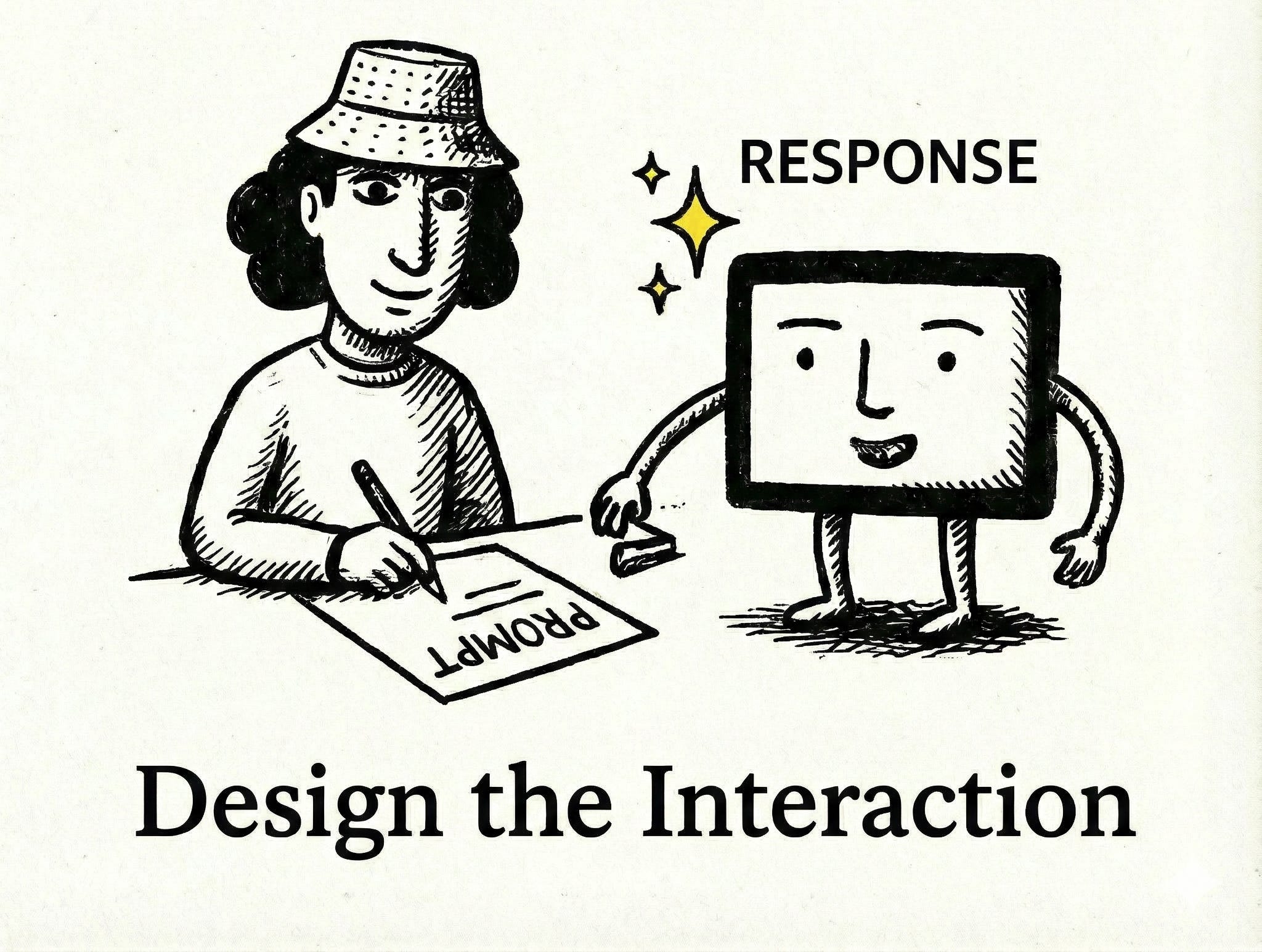
At the most minor scale, collaboration happens in micro-moments: writing, deciding, analyzing, and creating. The question isn’t “Should we automate this?” but “How should we divide up the task?”
Intentional teams choreograph tasks—deciding who leads, who critiques, and when the hand-off happens. They don’t delegate thinking to AI; they design human-in-the-loop moments where AI lays out possibilities and humans make the decision. This continuous turn-taking is how teams preserve judgment—by keeping humans in the rhythm of the conversation, not merely a checkpoint in the loop.
4. Design with Experimentation—Vibe Coding as Sketching
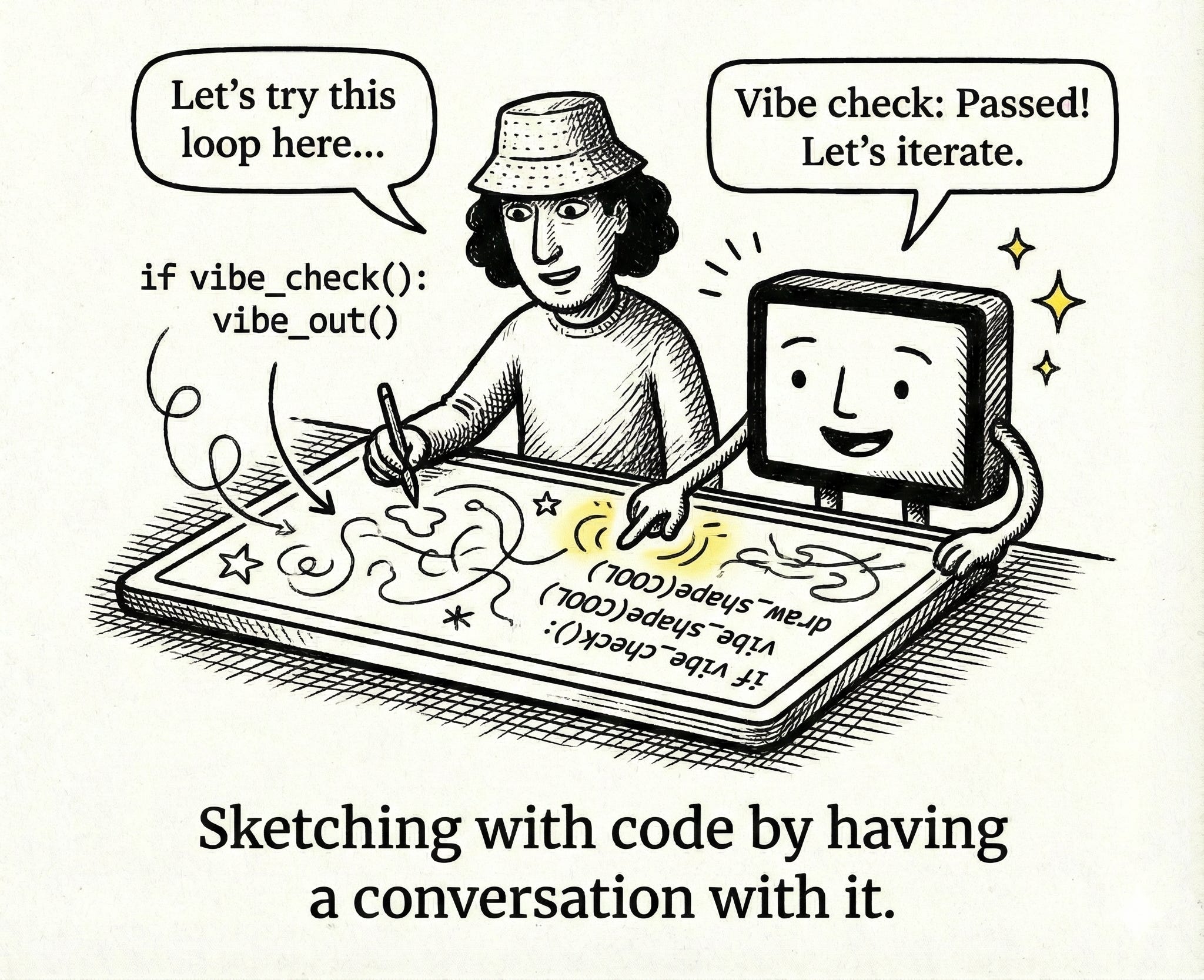
For decades, building software required learning programming languages. Today, natural language is the new syntax, enabling a new way of making that Andrej Karpathy calls “Vibe Coding.”
In vibe coding, the human focuses on the intent, the behavior, and the “vibe” of the output, while the AI handles the implementation details. For designers, this signals a profound shift: code has become a sketching material.
Much like sketching on paper allows us to explore ideas rapidly without committing to a final form, experimenting with AI will enable us to “sketch in code.” We can build working prototypes, test interactions, and iterate on solutions in real time, effectively lowering the bar for prototyping.
From Specs to Conversations: Instead of writing rigid requirement documents, we have a “conversation with materials”—a core tenet of design practice.
Low-Fidelity Code: We treat software not as a final engineering feat but as a disposable medium for testing hypotheses.
This approach democratizes making. It invites non-engineers to shape the product directly, turning the AI into a creative sandbox.
5. Design the Change—Culture as the Operating System
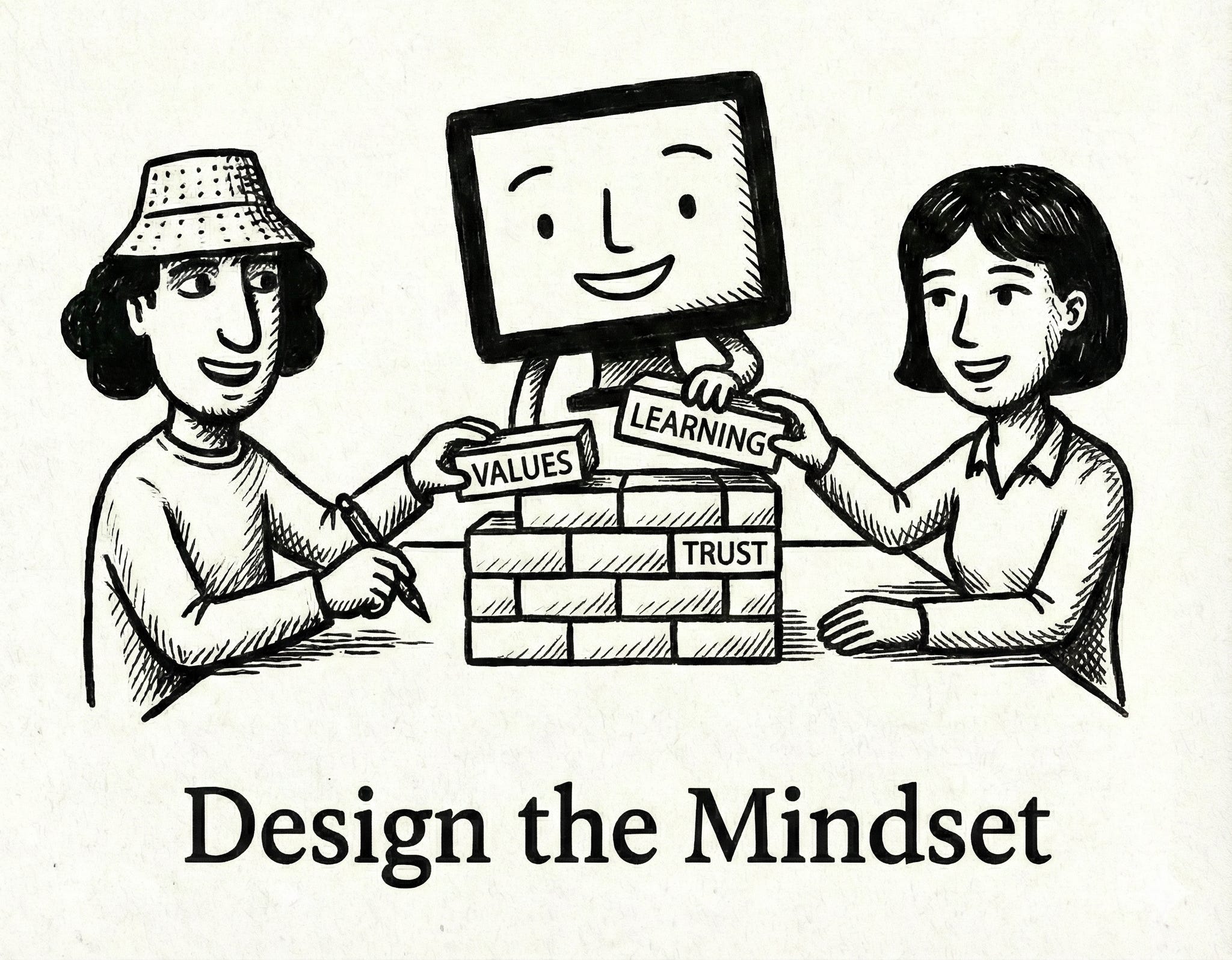
Even the most thoughtful team, workflow, or task design will stall if the culture around it resists change. Integrating AI isn’t just a product rollout; it’s a cultural translation—a new way of seeing and doing work.
In my Designing Organizational Culture [11] class, we treat culture as a living system of visible and invisible forces —values, rituals, stories, and practices — that shape behavior. To make AI integration stick, we must design the change program itself—the campaigns, rituals, and communication channels that turn intention into habit.
That means:
Campaigns that frame the narrative (“what’s in it for us”).
Policies that codify mindsets and practices
Team rituals that normalize experimentation (e.g., AI Review Fridays, Prompt Swaps).
A communication strategy that makes learning public, not private.
Leadership stories that reframe AI from replacement to partnership.
Designing the change means treating culture as infrastructure—the invisible operating system that either resists or sustains transformation [9, 10].
Toward a Culture of Intentional Integration
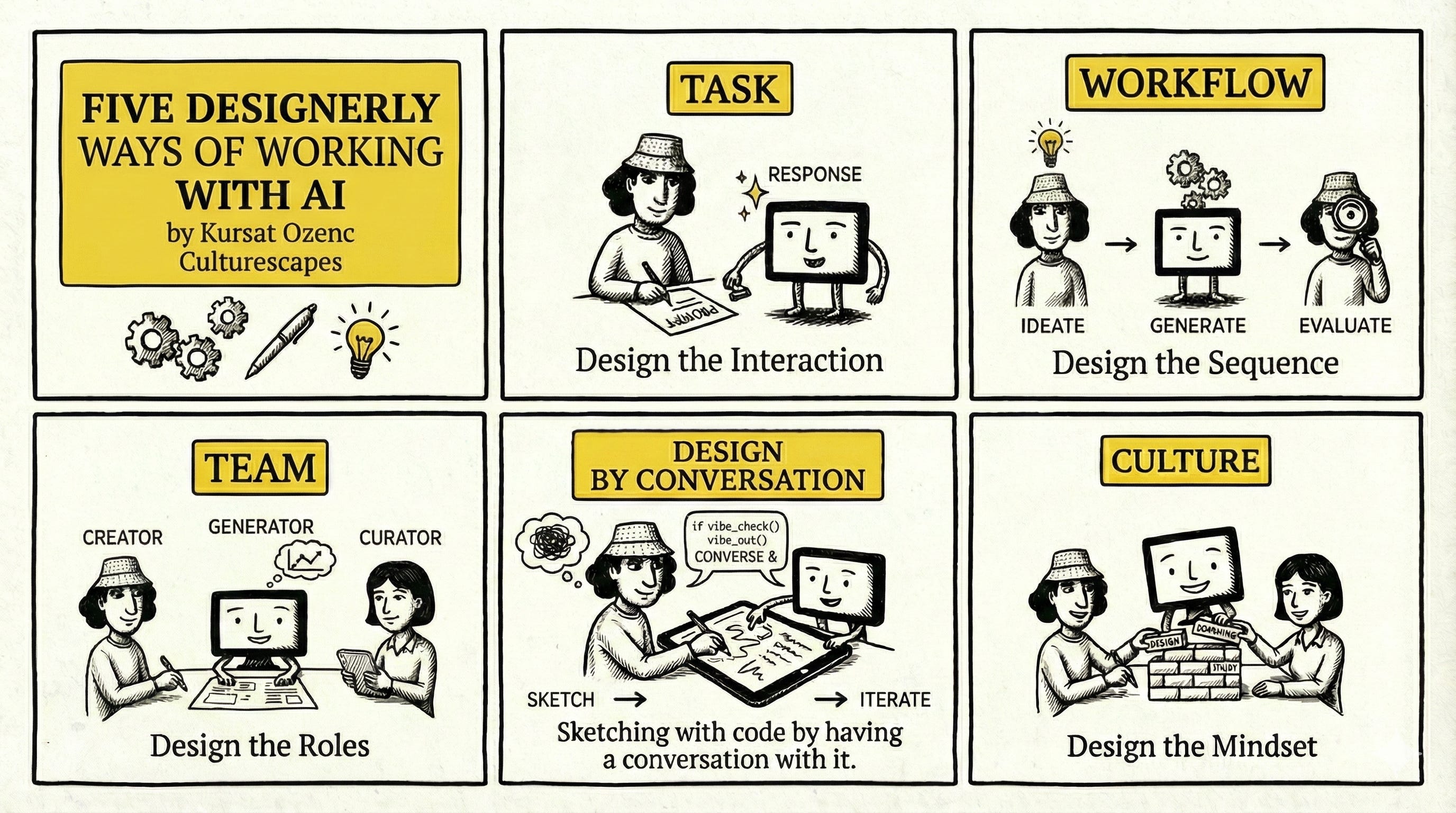
Across these five layers—team, workflow, task, experimentation, and culture—runs a single truth:
AI integration is not a technology problem; it’s a culture-design challenge.
The designerly way—starting with why, experimenting with form and material, and embedding new practices—offers a path forward. It’s how organizations could move from adoption to adaptation, from automation to co-creation, and from pilots that fail to practices that endure.
As I finish up this issue, I want to mention that this is still a work-in-progress POV, and I will have more updates as I explore the space more. I’d really enjoy hearing your thoughts on where AI could become a helpful teammate in your work, rather than just a tool. What intentional collaboration is possible there?
If you’re curious about the visuals accompanying this article, they’re a great example of human–AI collaboration. I drew the characters myself using the Paper app on my iPad, then passed them to ChatGPT for an initial iteration. After that, I asked Nano Banana to further refine and adapt the illustrations for different scenarios. I’ll share more about this mini-workflow in a future issue.
And that’s a wrap for this issue! Until next time, take good care of yourself and your loved ones.
Further Reading & References
[1] MIT Sloan Management Review / Tom’s Hardware Coverage. (2025). 95% of Generative-AI Implementations in Enterprise Have No Measurable P&L Impact.
Summarizes findings from MIT’s State of AI in Business 2025 report—failure attributed mainly to flawed workflow integration and poor translation of capability to culture.
https://www.tomshardware.com/tech-industry/artificial-intelligence/95-percent-of-generative-ai-implementations-in-enterprise-have-no-measurable-impact-on-p-and-l-says-mit-flawed-integration-key-reason-why-ai-projects-underperform
[2] RAND Corporation. (2024). Root Causes of AI Project Failure: Insights from Practitioner Interviews (RR-A2680-1).
Identifies organizational culture, governance gaps, and change-management weaknesses as the leading causes of the “> 80 %” AI-pilot failure rate.
https://www.rand.org/pubs/research_reports/RRA2680-1.html
[3] Google Re: Work / Project Aristotle. (2017). What Makes a Team Effective at Google?
Large-scale internal study establishing psychological safety as the top predictor of team performance.
https://rework.withgoogle.com/print/guides/5721312655835136/
[4] Beane, M. (2024, June 25). How Can We Preserve Human Ability in the Age of Machines? MIT Sloan Ideas Made to Matter.
Explains how professionals adapt through “shadow learning” to maintain skills as automation spreads.
https://mitsloan.mit.edu/ideas-made-to-matter/how-can-we-preserve-human-ability-age-machines
[5] Budzyn et al. (2025). Artificial-intelligence-assisted colonoscopy and the risk of skill decay: A multicentre study. Gastroenterology Report, 13(2), graf035.
Demonstrates measurable skill decay among clinicians routinely using AI assistance.
https://www.sciencedirect.com/science/article/abs/pii/S2468125325001335
[6] CBC News. (2024). Air Canada Held Liable for Chatbot Error.
Landmark case confirming that companies remain responsible for misinformation produced by their AI systems.
https://www.cbc.ca/news/canada/british-columbia/air-canada-chatbot-ruling-1.7098555
[7] Hackman, J. R. (2002). Leading Teams: Setting the Stage for Great Performances. Harvard Business Press.
Classic framework on team purpose, structure, and enabling conditions.
[8] Edmondson, A. C. (2018). The Fearless Organization: Creating Psychological Safety in the Workplace for Learning, Innovation, and Growth. Wiley.
Defines psychological safety as the foundation of learning behavior in teams.
[9] Schein, E. H., & Schein, P. (2017). Organizational Culture and Leadership (5th ed.). Wiley. Frames culture as the invisible infrastructure shaping organizational change.
[10] Ozenc, K., & Hagan, M. (2019). Rituals for Work. Wiley.
Introduces design methods for building cultural practices that reinforce behavioral change.
[11] Ozenc, K. (2025). Designing Organizational Culture Course Materials, Stanford d.school.
See also www.designingorgculture.com.
[12] Fortune. (2025, May 9). As Klarna flips from AI-first to hiring people again. Reports on Klarna’s shift back toward human roles after realizing diminishing returns on full AI automation.
https://fortune.com/2025/05/09/klarna-ai-humans-return-on-investment
[13] Fast Company. (2025, May 10). Going “AI-first” appears to be backfiring on Klarna and Duolingo. Describes operational and brand setbacks after early AI-first transitions.
https://www.fastcompany.com/91332763/going-ai-first-appears-to-be-backfiring-on-klarna-and-duolingo